

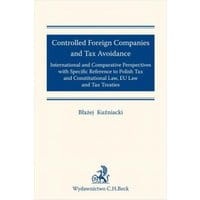
Controlled Foreign Companies (CFC) and Tax Avoidance: International and Comparative Perspectives with Specific Reference to Polish Tax and Constitu...
Dostępność:
duża ilość
Wysyłka w:
24 godziny
Cena:
314,33 zł
Cena regularna:
Najniższa cena z 30 dni przed obniżką:
towar niedostępny
 dodaj do przechowalni
Ocena:
0
0
Producent:

Kod produktu:
26689849003
Opis
The lion's share of global investments are likely being conducted for tax avoidance purposes through controlled foreign companies (CFC) established in tax havens or low tax jurisdictions. Avoiding tax via CFCs causes several problems, in particular it: leads to the unfair and unbalanced taxation of income; may widen the gap between the poorest and the richest, which then further adversely affects sustainable development; erodes a state's tax base, which undermines the integrity of the tax system; and it can harm fair competition among enterprises. Given the negative consequences of tax avoidance via CFCs, the author has worked hard to improve provisions specifically designed to prevent tax avoidance via CFCs – the CFC rules. As a result of in-depth international and comparative research and analysis, I this book the author sets out proposals amending the CFC rules in a way that would increase a state's ability to effectively prevent tax avoidance schemes, while at the same time shielding genuine cross-border economic activities. Even though the analysis and conclusions (proposals) concern the Polish CFC rules, in principle they are relevant to the CFC rules of other countries as well, and may be used as a yardstick by countries without CFC rules at present to draft rules of their own. The proposals ensure an appropriate balance between preserving the domestic tax base and fostering competitiveness. They aim to be compatible with constitutional law, EU/EEA law and tax treaties, and they resonate with the most recent thinking of the OECD on the issue under BEPS and the GloBE proposal (Pillar Two) in many instances. In this way, the proposals may contribute to the fair and balanced taxation of income, and may help narrow the gap between the poorest and the richest, which would positively affect sustainable development. If the author's proposals are implemented by states, the concept of controlled foreign companies will no longer be synonymous with tax avoidance.
